
Malcolm L. MacGregor | April 14, 2026 | Car accidents

One of the first questions many people have after a car accident in Pennsylvania is who will pay for their medical bills and other expenses. The answer depends in large part on the type of insurance system the state uses. Unlike most states, where the at-fault driver’s insurance covers the victim’s losses, Pennsylvania follows a “choice” no-fault model that often changes how the process works.
If you were recently involved in a car accident, learning about this system is important for protecting your legal rights. Continue reading to learn about how no-fault insurance works in Pennsylvania and when you may be able to step outside of it.
How No-Fault Insurance Works in Pennsylvania
Pennsylvania is one of the rare states that operates under a no-fault car insurance system, at least in one form or another. Broadly speaking, drivers usually turn to their own insurance policy first after an accident under this type of model, regardless of who caused the crash. This coverage is often referred to as Personal Injury Protection (PIP), though Pennsylvania specifically calls it “Medical Benefits.”
This coverage is designed to cover expenses like medical bills without the need to prove that another driver was at fault. The goal of the system is to make sure injured drivers can access compensation quickly rather than waiting for a lengthy legal process to play out.
However, this system also comes with a significant trade-off. In exchange for guaranteed access to these benefits, your ability to file a lawsuit against the at-fault driver may be limited.
Full Tort vs. Limited Tort Coverage
One feature that makes Pennsylvania’s system unique is that drivers get to choose between two coverage options when purchasing auto insurance: full tort and limited tort.
If you select full tort coverage, you retain the right to sue the at-fault driver for all of your economic and non-economic damages, including pain and suffering, no matter how serious your injuries are. This option typically comes with a higher premium, but it gives you the broadest legal protections after a crash.
If you selected limited tort coverage, your right to sue is more restricted. Under limited tort, you can still recover compensation for your medical expenses through your no-fault policy. However, you generally cannot sue for all of your damages unless your injuries meet a certain threshold of seriousness.
When Can I Sue the At-Fault Driver?
If you have limited tort coverage, there are a few exceptions that may allow you to file a lawsuit. For example, Pennsylvania law permits limited tort drivers to take action in this way if they suffered what the law considers a “serious injury.” This can include:
- Permanent disfigurement
- Serious impairment of a body function
You can also take action against the at-fault driver to recover compensation for any property damage to your vehicle. The no-fault rules apply specifically to injuries and damages stemming from those injuries.
Pennsylvania’s Comparative Negligence Rule
If you are eligible to file a lawsuit after your accident, Pennsylvania’s comparative negligence law may also come into play. Per 42 Pa. C.S. § 7102, you can still recover damages as long as your share of fault does not exceed 50%. From there, your compensation will be reduced by whatever percentage of fault is assigned to you.
For example, if you are found to be 25% at fault and your total damages are $100,000, your recovery would be reduced to $75,000. However, note that this law will not apply to claims against your own Medical Benefits coverage.
Contact a Pennsylvania Car Accident Lawyer at McDonald & MacGregor, LLC for a Free Consultation
Pennsylvania’s “choice” no-fault system can make it difficult to understand your rights after a crash. An experienced car accident lawyer can help you navigate your options and determine the best path forward.
The team at McDonald & MacGregor, LLC is ready to guide you through the process and fight for the compensation you deserve. With contingency-based representation, you pay no attorney’s fees unless your case is successful. Contact us today to schedule your free consultation.
We proudly serve Scranton, Wilkes-Barre, Hazleton, Luzerne County, Lackawanna County, and surrounding areas.
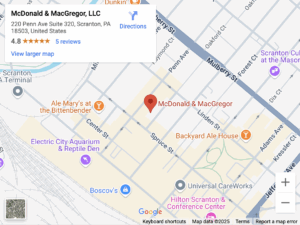
McDonald & MacGregor, LLC
220 Penn Ave Suite 320, Scranton, PA 18503
(570) 209-7062
Scranton Office
220 Penn Ave Suite 320, Scranton, PA 18503
(570) 209-7062